


Dog Food Study

dog looking at his bowl as an owner pours dry kibble
dog lying next to a bowl full of dry kibble

Why Dog Food?

Dog owners worldwide feed their dogs multiple times a day, relying on dog food to provide essential nutrition at every stage of life. They expect the products to be free from harmful heavy metals and industrial chemicals.


At Clean Label Project , we do not take safety claims at face value — we rely on data and scientific evidence to uncover what contaminants consumers are exposed to. Our mission is to champion and safeguard transparency.


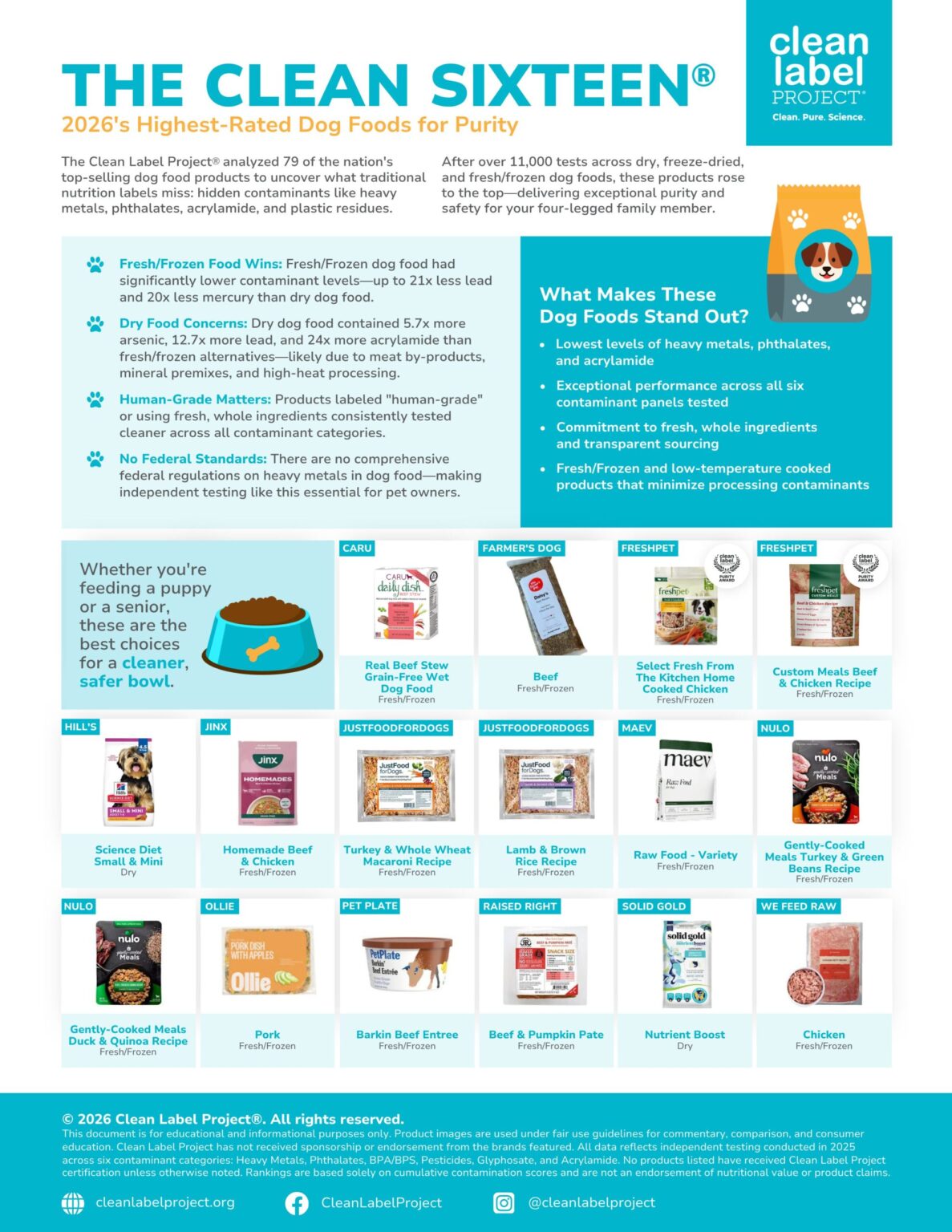
The global dog food market size was valued at $72.58 billion in 2024, with North America representing over 35% of the market. Many pet owners care for their dogs as deeply as parents care for their children, hoping to ensure long, happy, and healthy lives, and trusting that the food they give their dogs meets their nutritional needs. However, the Clean Label Project’s Dog Food Category Report reveals that many popular dog foods fall short – and may even be harmful – containing dangerous levels of heavy metals, acrylamide, and plastic contaminants.


This report, which tested 79 top-selling dry, freeze-dried, and fresh/frozen dog food products, raises concerns that call into question current assumptions about product safety and purity.

Click on the button above to access to the largest known dog food ingredient & contaminant database in the world!


This FREE tool allows anyone with the list of ingredients in their dog’s food to be able to run a prediction, powered by machine learning, as to the levels of contamination that could be found in the final product.

Stay Informed. Demand Cleaner.

Click the button below to download the BRAND NEW CLP Mobile App!

Google Play Store App coming soon!

What was the Clean Label Project’s Methodology?

Clean Label Project purchased and rigorously evaluated 79 of the top-selling dry, air-dried, freeze-dried, and fresh/frozen dog foods. The scope of testing assessed multiple panels of industrial and environmental contaminants. Collaborating with Ellipse Analytics, an ISO 17025-accredited analytical chemistry laboratory, Clean Label Project amassed over 11,376 individual data points from those 79 products to benchmark the findings.

What Contaminants Were Found in Clean Label Project’s Dog Food Study?


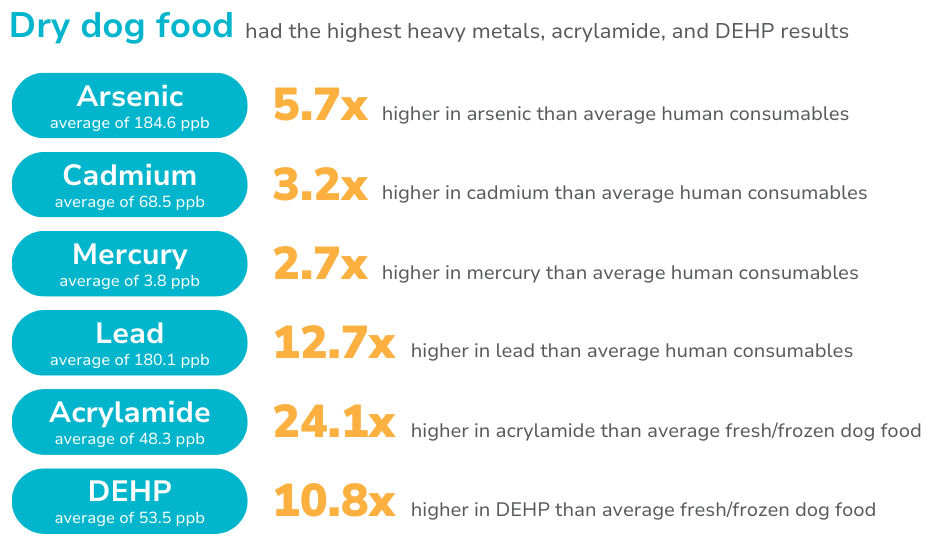
The Bad News – Dry Dog Food:

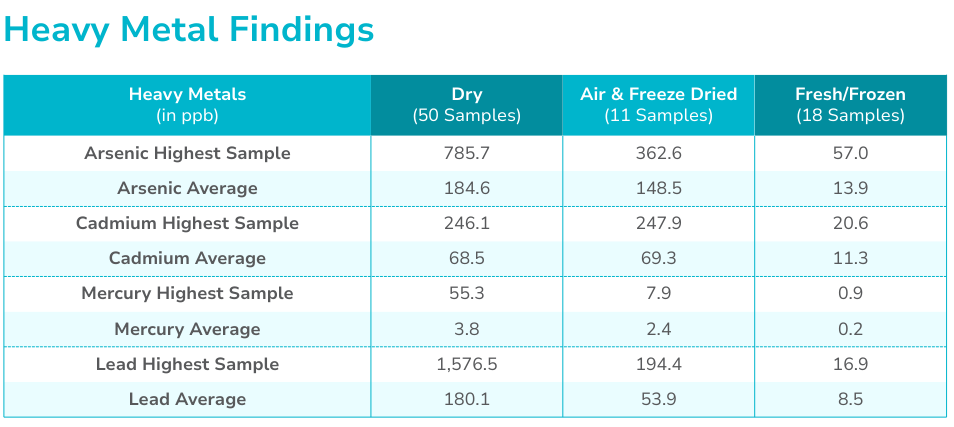
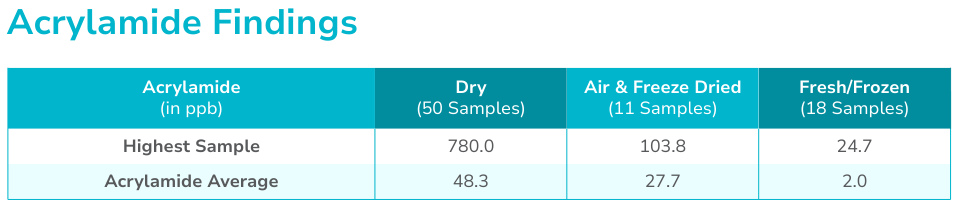
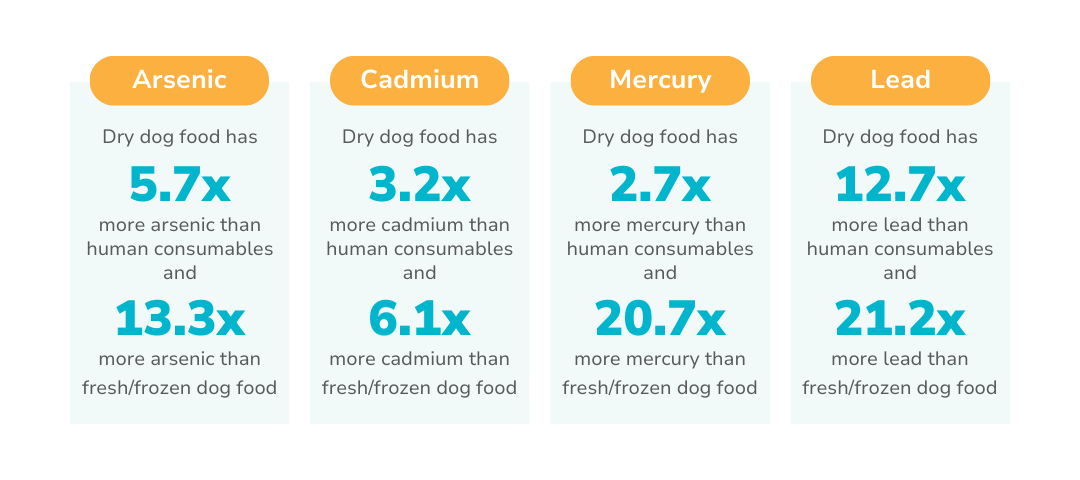
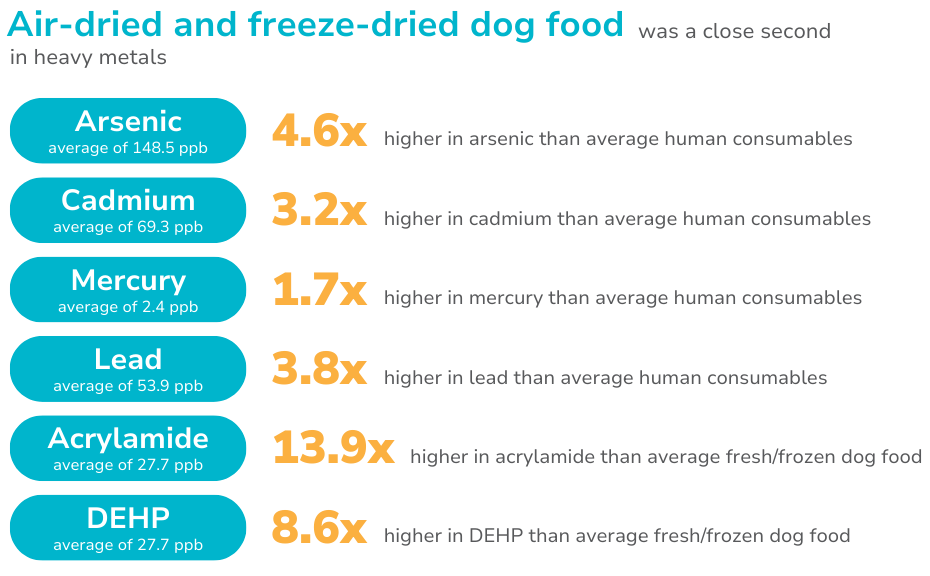
  • The Clean Label Project found an exceedingly high amount of arsenic, cadmium, mercury, and lead in dry, air-dried, and freeze-dried dog food. Because there are few regulations for dog food related to contaminants, Clean Label Project compared these findings to data from 3,280 food, beverage, and supplement samples tested over the past 10 years, using the averages to illustrate the elevated contaminant levels in dog food compared to human-consumable products. Over 85% of dog food owners feed their dog dry dog food.


The Good News – Fresh/Frozen Dog Food:

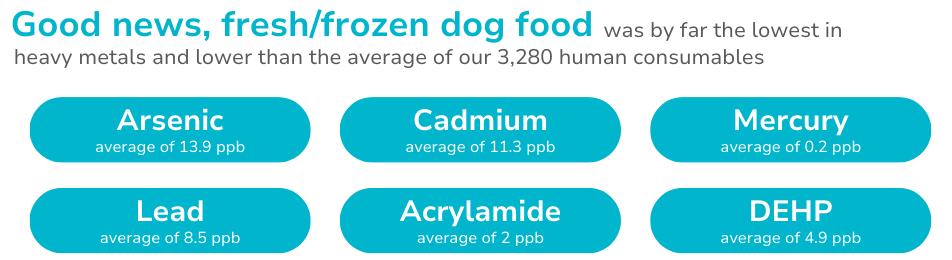
  •  Fresh/Frozen dog food samples we tested were lower in contaminants than our human consumables benchmark from over 3,280 products. Furthermore, on average, fresh/frozen dog food was found to have exponentially lower contaminants than dry dog food.

    To illustrate the difference in heavy metals levels in dry dog food vs. fresh/frozen dog food and human consumables is striking.


Does Serving Size Matter?

When a test result is typically applied to a serving size, the contamination result will often change to some degree. However, when it comes to dog food, we found that the impact of serving size doesn’t demonstrate much variation in the level of heavy metal contamination. Dog food, in general, has a very large serving size compared to human food. As the following serving size results table demonstrates, there was no significant difference in the test results variances between dry and fresh/frozen.
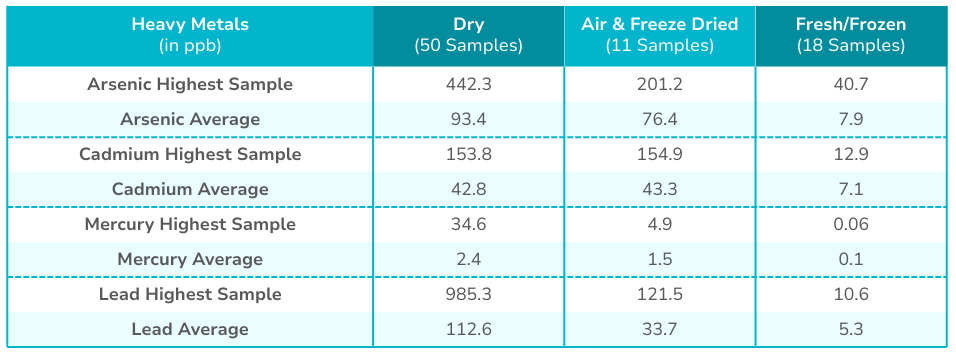
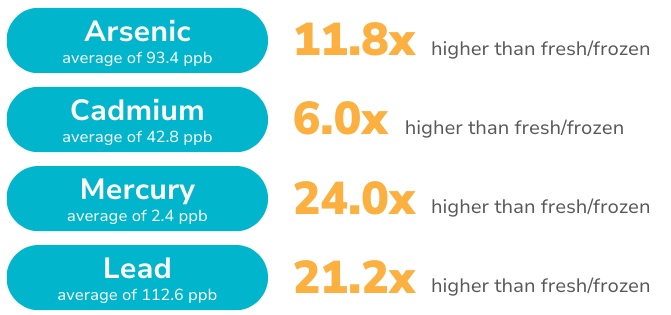
When we adjusted the raw data (above) to the recommended serving size, dry dog food is still exponentially higher in heavy metals than fresh/frozen. With the recommended serving size, Dry Dog Food has the highest heavy metal result:
Aren’t These Contaminants Regulated?

There are no comprehensive federal regulations specifically addressing dietary exposure to industrial and environmental chemicals in dog food, as most safety measures concentrate on physical and microbiological contaminants.

Where are These Contaminants Coming From?

The elevated levels of heavy metals in dry, air-dried, and freeze-dried dog food can originate from multiple sources. Based on our research, we believe three key ingredients are the primary contributors:

 

Meat by-products consist of the parts of an animal that remain after the cuts consumed by humans are removed. This includes organs such as the livers, lungs, kidneys, and spleens, as well as bones, and other tissues. The by-products are then processed to create a meat by-product meal, which is commonly used in many dry dog foods. Heavy metals tend to concentrate in the organs and bones, which leads to higher levels of these heavy metals in dog food.


Vitamin and mineral premixes are added to many dog foods to ensure pets get the essential nutrients they need. Vitamin and minerals can naturally contain or consist of trace metals. It remains unclear whether factors like country of origin, regulatory oversight, inspection practice (announced versus unannounced), and supply-chain complexity – where ingredients change hands multiple times, making traceability more difficult – have any impact. All of these areas merit further study.

Many dog foods include seafood and plant-based carbohydrates, but these ingredients can introduce heavy metals. Seafood often contains high levels of mercury, and certain grains and root vegetables can accumulate metals like arsenic from the soil, such as
arsenic in rice.


Individually, each one of these ingredients may contribute only minimally to heavy metal levels. However, when all three are combined in a single dry dog food product, their cumulative effect can result in a substantial increase in heavy metals.

How Does Clean Label Project Measure These Contaminants?

Clean Label Project partnered with the independent analytical chemistry laboratory, Ellipse Analytics, to test six panels of industrial chemicals:
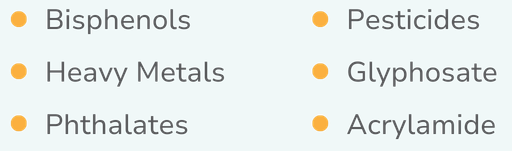
 

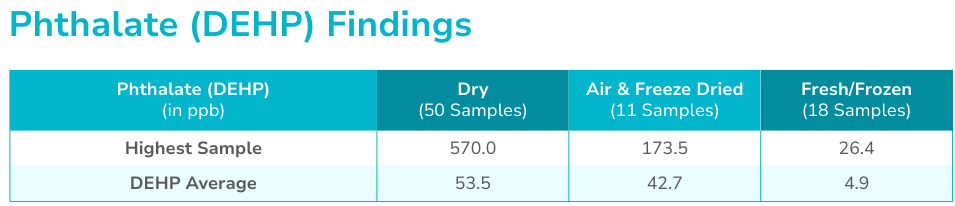
The heavy metals (arsenic, cadmium, lead, and mercury), were tested by Inductively Coupled Plasma – Mass Spectroscopy (ICP-MS); Phthalates were tested by Gas Chromatography – Mass Spectroscopy (GC-MS/MS); and Bisphenols, glyphosate, and pesticides were
tested by Liquid Chromatography – Tandem Mass Spectroscopy (LC-MS/MS).
What Should Content-Conscious Consumers Look For?

Our mission is to empower consumers by delivering accurate and reliable product information based on our testing and analysis of the products they purchase. This data enables consumers to make informed choices that prioritize safety and quality in the dog food they purchase.

“The love and joy a dog brings to a family are immeasurable,” said Molly Hamilton, Executive Director of Clean Label Project®. “Every dog owner should feel confident that the food they give their pup is nutritious and free from harmful substances.”


The following companies have dog foods that are Clean Label Project Certified: ®

Frequently Asked Questions about Protein Powder 2.0

What was the Clean Label Project’s Methodology?

Clean Label Project purchased and rigorously tested 160 of the top-selling protein powders, sourced from Nielsen and Amazon’s best-seller lists, and supplemented with top products from the natural and organic marketplace. It also assessed multiple panels of industrial and environmental contaminants. Collaborating with an analytical chemistry lab, Clean Label Project amassed 35,862 data points from 70 brands and 160 products to benchmark the findings.

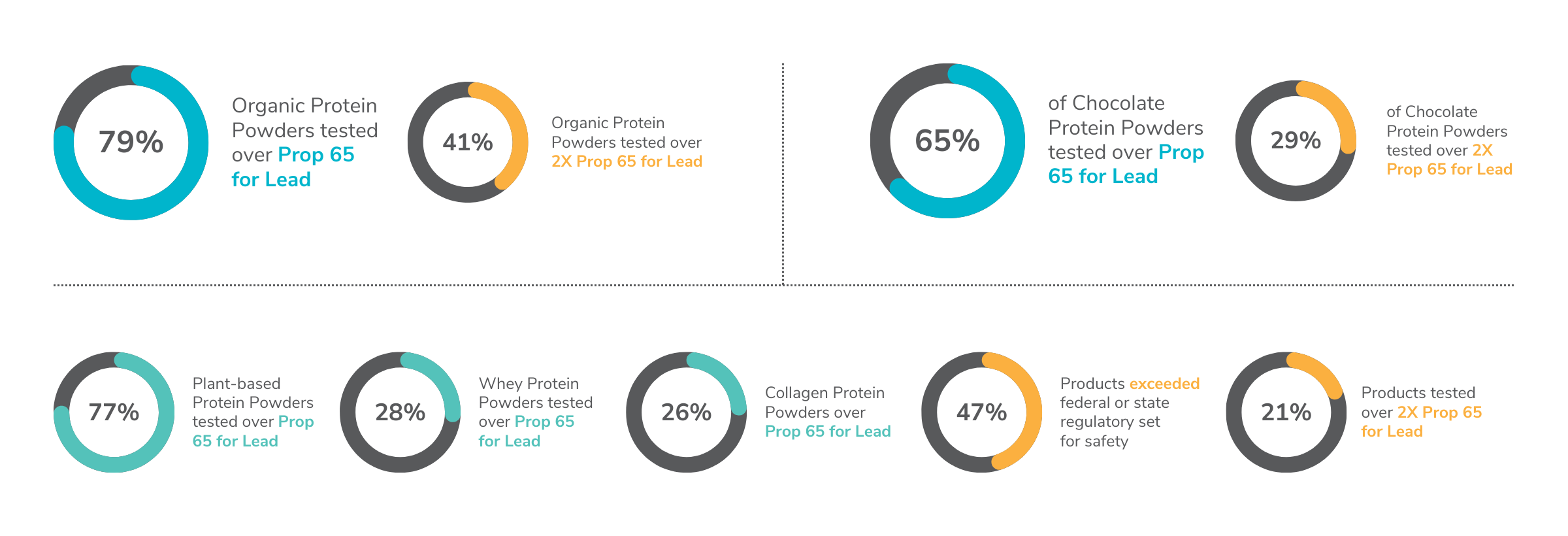
Protein powders tested by Clean Label Project had an array of positive results for levels of arsenic, cadmium, lead, and mercury. However, 47% of products exceeded at least one federal or state regulatory set for safety, including CA Prop 65, and 21% of the samples were over 2X CA Prop 65 levels.

– Heavy metals, such as arsenic, lead, mercury, and cadmium, are naturally occurring elements found in the Earth’s crust.

They enter the environment through natural processes like volcanic eruptions, weathering of rocks, and soil erosion. Over time, they accumulate in air, water, and soil, where they can make their way into plants, animals, and eventually into human food sources. Though naturally occurring, the concentration of these metals can increase due to human activities such as mining, industrial processes, and agricultural practices, leading to higher exposure risks in food products. Given the absence of federal regulations that require proactive testing to minimize the introduction into finished products, they can be unintentionally introduced into all foods and consumer products. Interestingly, certified organic products were found to have, on average, three times the lead compared to non-organic products. This was largely due to plant-based protein powders, which tend to contain higher levels of contaminants. Our studies continue to report chocolate as a high-risk ingredient.

– 65% of Chocolate Protein Powders tested over Prop 65 levels and 29% tested over 2X Prop 65.

Bisphenols, including BPA and BPS, are well-known endocrine disruptors with significant health risks. Research has shown that BPA can interfere with insulin tolerance, potentially undermining athletic training efforts for those using protein powders (Moon et al., 2015). Additionally, BPA is linked to metabolic issues, increasing the risk of type II diabetes (Le Magueresse-Battistoni et al., 2018). Fortunately, Clean Label Project’s 2023-2024 study found a significant improvement from 2018, with BPA and BPS detected in only 3 of 160 protein powder products, compared to 55% in previous tests. Plant-based protein powders were the most contaminated, containing five times more cadmium than their whey-based counterparts. Even the flavor of protein powder played a significant role in contamination levels. Chocolate protein powders, for instance, were found to have a staggering 110 times more cadmium [1] than vanilla-flavored varieties. Meanwhile, whey-based protein powders generally showed much lower contaminant levels, highlighting the variability in product safety depending on the protein source and flavoring.

Surprisingly, there are no comprehensive federal regulations specifically targeting dietary exposure to heavy metals in food, with most safety efforts focused on physical and microbiological contaminants. However, recent discussions in Congress and the FDA are pushing for stricter standards on heavy metals and industrial chemicals in food products. States like California have created regulations, like Prop 65 that we reference. Prop 65 requires businesses to provide warnings about significant exposures to chemicals that cause cancer, birth defects or other reproductive harm. CA and MD have led the charge with transparency laws for heavy metals in baby food (CA AB899 & MD SB723).

The two primary sources of contaminants in protein powders are the contaminated soils where ingredients are grown, and the packaging used for these products. At the agricultural level, companies can hold suppliers accountable to minimize pesticide and soil contamination during the growth cycle of their ingredients. However, the good news is that packaging has seen significant improvements in terms of BPA content. Clean Label Project’s testing indicates that BPA has been nearly eliminated from packaging, reflecting the industry’s response to consumer demand and controversy surrounding this chemical.

Clean Label Project contracted an independent analytical chemistry laboratory, Ellipse Analytics, to test 6 industrial chemical panels, including heavy metals and BPA.The heavy metals, arsenic, cadmium, lead, and mercury, were tested by Inductively Coupled Plasma–Mass Spectroscopy (ICP-MS). Bisphenols and pesticides are tested by liquid Chromatography–Tandem Mass Spectroscopy (LC-MS/MS).
Our mission is to empower consumers to see beyond flashy marketing. When it comes to selecting low-contaminant options, our findings reveal that plant-based protein powders generally had the highest levels of detected contaminants, while whey-based protein powders consistently demonstrated lower levels. The data from this protein study, enables consumers to make informed choices that prioritize safety and quality in their dietary supplements. Based on our study, the products with the least lead are whey or collagen-based protein powders that are not chocolate-flavored.

The following companies have protein powders that are Clean Label Project Certified:

“The food industry owes their customers an open, honest, and transparent view of how clean their ingredients are,” explains Jaclyn Bowen from Clean Label Project. “Consumers are purchasing supplement and protein products for health and performance, they expect the products to be clean.”

Transparency laws like CA AB899 and Maryland “Rudy Law” is the future for consumer trust and industry change. Clean Label Project has a Transparency certification that displays the results of all certified brands lots providing consumers with the confidence to make the right informed decisions. We believe there is a growing concern about food and supplement safety and a growing demand for transparency.

Currently only one protein company, Puori, is certified to Clean Label Project Transparency Certification but we encourage more brands to seek Transparency Certification providing consumers with the trust they deserve.